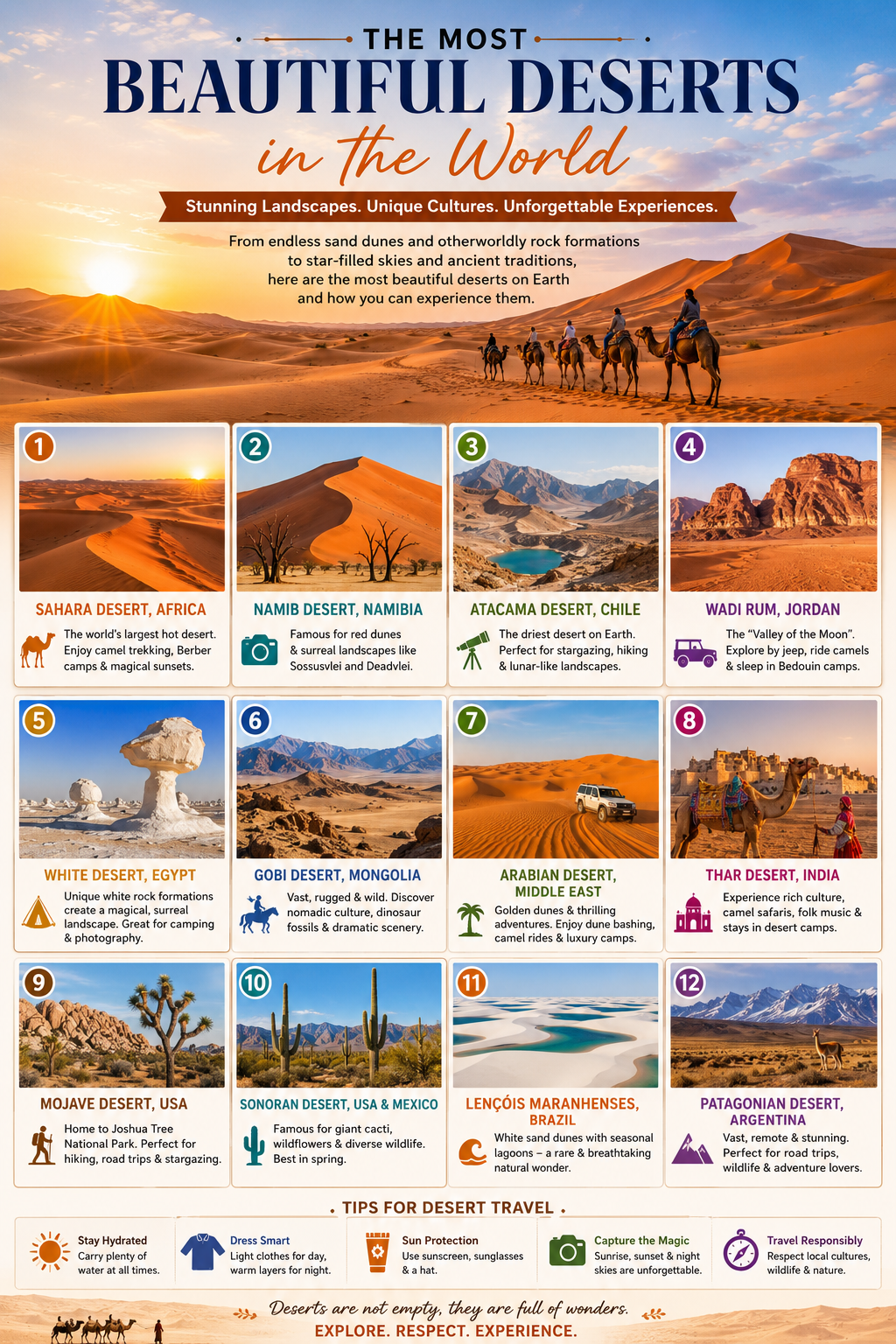
Deserts are some of the most fascinating landscapes on Earth. Far from being empty and lifeless, they are filled with dramatic sand dunes, colorful rock formations, ancient cultures, unique wildlife, and breathtaking sunsets. From the golden sands of the Sahara to the otherworldly landscapes of the Atacama, the most beautiful deserts in the world offer unforgettable experiences for adventurous travelers.
Whether you want to ride camels across towering dunes, sleep beneath a sky full of stars, explore ancient valleys, or photograph incredible landscapes, these deserts deserve a place on your travel bucket list.
1. Sahara Desert, Africa
The Sahara is the world’s largest hot desert and one of the most iconic destinations for desert adventures. Stretching across much of North Africa, it covers an enormous area and features towering sand dunes, rocky landscapes, oases, and ancient settlements.
Morocco is one of the most popular gateways for travelers. The dunes around Merzouga are particularly spectacular, especially at sunrise and sunset.
Visitors can enjoy camel trekking, 4×4 desert tours, traditional Berber camps, sandboarding, and overnight stays beneath the stars. Spending a night in a desert camp is one of the best ways to experience the Sahara.
Best for: Camel rides, desert camps, photography, sunsets, and cultural experiences.
2. Namib Desert, Namibia
The Namib Desert is famous for its dramatic red-orange sand dunes and spectacular landscapes. Some of the world’s tallest sand dunes can be found around Sossusvlei, making this one of Africa’s most photogenic destinations.
The contrast between the bright dunes, deep blue sky, and white salt pans creates an almost surreal environment. Deadvlei, with its ancient dark trees surrounded by enormous dunes, is especially famous among photographers.
Travelers can explore the desert by 4×4, climb dunes, take scenic flights, and enjoy sunrise photography.
Best for: Photography, dune climbing, wildlife, and dramatic landscapes.
3. Atacama Desert, Chile
The Atacama Desert is one of the driest places on Earth and offers landscapes that look almost like another planet. Located in northern Chile, it features salt flats, volcanoes, rocky valleys, geysers, and colorful lagoons.
The Valle de la Luna, or Moon Valley, is one of the region’s most popular attractions. Its unusual rock formations and dry landscape create an otherworldly atmosphere.
The Atacama is also renowned for its exceptionally clear skies. Travelers can join astronomy tours and observe stars, planets, and distant galaxies with powerful telescopes.
Best for: Stargazing, hiking, photography, and unusual landscapes.
4. Wadi Rum, Jordan
Known as the “Valley of the Moon,” Wadi Rum is famous for its enormous sandstone mountains, red sand, narrow canyons, and ancient rock inscriptions.
The desert has a strong connection to Bedouin culture and has also been used as a filming location for numerous movies because of its spectacular scenery.
Visitors can take a jeep tour through the desert, ride camels, climb rock formations, or spend the night in a Bedouin-style camp. Watching the sunset over the red landscape is an unforgettable experience.
Best for: Adventure, camping, culture, jeep tours, and photography.
5. White Desert, Egypt
Egypt’s White Desert is unlike traditional golden-sand deserts. Located in the Farafra region, it is famous for enormous white chalk formations sculpted by wind and erosion.
Some formations resemble giant mushrooms, animals, or abstract sculptures. At sunset, the white landscape changes color dramatically, creating a magical atmosphere.
Camping overnight allows travelers to experience the area’s peaceful surroundings and incredible night sky.
Best for: Photography, camping, geology, and unique landscapes.
6. Gobi Desert, Mongolia
The Gobi Desert is one of the world’s largest deserts and stretches across southern Mongolia and northern China. Unlike the classic image of a sandy desert, the Gobi contains rocky plains, gravel landscapes, mountains, and sand dunes.
The Mongolian Gobi is perfect for travelers seeking remote adventures. Visitors can explore by jeep, stay in traditional ger camps, meet local nomadic communities, and search for wildlife.
The Flaming Cliffs are another fascinating attraction, famous for important dinosaur fossil discoveries.
Best for: Wildlife, fossils, nomadic culture, road trips, and adventure.
7. Arabian Desert, Middle East
The Arabian Desert covers a huge part of the Arabian Peninsula and offers spectacular golden dunes, rocky landscapes, and traditional desert experiences.
The desert can be experienced in several countries, including the United Arab Emirates, Oman, and Saudi Arabia. Dubai and Abu Dhabi are particularly popular gateways for desert safaris.
Visitors can enjoy dune bashing, camel rides, sandboarding, traditional meals, and luxury desert camps. For a quieter experience, Oman offers beautiful desert landscapes around areas such as Wahiba Sands.
Best for: Desert safaris, luxury camping, dune activities, and cultural experiences.
8. Thar Desert, India
The Thar Desert, also called the Great Indian Desert, is located mainly in northwestern India and extends into Pakistan. Rajasthan provides some of the most accessible and culturally rich desert experiences.
Jaisalmer is often called the “Golden City” because of its sandstone architecture and location near the desert. Travelers can take camel safaris, visit desert villages, enjoy folk performances, and spend nights in traditional camps.
The desert becomes particularly magical around sunset when the dunes glow golden.
Best for: Culture, camel safaris, architecture, photography, and traditional experiences.
9. Mojave Desert, USA
The Mojave Desert is one of the most diverse desert landscapes in the United States. It features rugged mountains, Joshua trees, dry valleys, enormous rock formations, and colorful sunsets.
Joshua Tree National Park is one of the region’s best-known destinations. Its distinctive Joshua trees and giant boulders create a unique landscape.
The desert is ideal for hiking, camping, photography, road trips, and stargazing.
Best for: Road trips, hiking, camping, rock formations, and photography.
10. Sonoran Desert, USA and Mexico
The Sonoran Desert is famous for its iconic giant saguaro cacti. Unlike many deserts, it receives enough seasonal rainfall to support a surprisingly diverse range of plants and wildlife.
Arizona is one of the best places to explore this desert, particularly around Saguaro National Park near Tucson.
Spring can be especially beautiful when desert flowers bloom. Visitors can enjoy hiking, wildlife watching, scenic drives, and photography.
Best for: Cacti, hiking, wildlife, wildflowers, and scenic drives.
11. Lençóis Maranhenses, Brazil
Lençóis Maranhenses is one of the most unusual desert-like landscapes in the world. Located in northeastern Brazil, it features enormous white sand dunes separated by seasonal freshwater lagoons.
The landscape changes throughout the year as rainfall fills the lagoons between the dunes. This creates a stunning contrast between bright white sand and turquoise or blue water.
Visitors can explore the dunes by 4×4, swim in the lagoons, and photograph the incredible scenery.
Best for: Photography, swimming, adventure, and unusual landscapes.
12. Patagonian Desert, Argentina
The Patagonian Desert is one of the largest deserts in South America. Instead of endless sand dunes, it features windswept plains, rocky landscapes, mountains, and dramatic valleys.
Its remote setting makes it ideal for travelers who want to escape crowded tourist destinations. The region is also home to fascinating wildlife and spectacular natural scenery.
Road trips through Patagonia can provide incredible opportunities for photography and outdoor exploration.
Best for: Road trips, wildlife, hiking, and remote landscapes.
Tips for Exploring the World’s Deserts
Desert travel can be unforgettable, but preparation is important. Temperatures can change dramatically between day and night, so travelers should pack appropriate layers.
Always carry sufficient water and protect yourself from the sun with sunscreen, sunglasses, and a hat. Comfortable shoes are essential if you plan to hike or climb dunes.
It’s also wise to travel with experienced local guides, particularly in remote deserts. Respect local communities, wildlife, and fragile desert ecosystems.
For photography, sunrise and sunset are usually the best times because the softer light creates dramatic shadows and enhances the colors of the landscape.
Final Thoughts
The most beautiful deserts in the world prove that deserts are far more diverse than endless stretches of sand. From the towering dunes of Namibia and the golden landscapes of the Sahara to the chalk formations of Egypt and the lagoons of Brazil, each destination has its own unique character.
Desert travel offers more than beautiful scenery. It provides opportunities to experience different cultures, discover unusual wildlife, sleep under spectacular stars, and explore some of Earth’s most remote environments.
Whether you’re an adventure seeker, photographer, nature lover, or simply looking for an extraordinary vacation, these spectacular deserts offer experiences that you’ll remember long after your journey ends.